As the climate gets ever hotter and drier, thousands have been forced into scouring the soil for riches
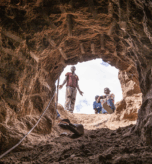
Maria Nakoru crouches at the bottom of a dirt hollow, one metre deep. She grips a metal pike as she strikes the walls, chasing glimmers of gold through the choking dust.
In Uganda’s northeastern Karamoja region, thousands of artisanal miners carve a fragile livelihood from the earth. Nearby, others labour in their own plots, surrounded by mounds of soil, like freshly dug graves. A breeze lifts the ochre hue of the parched dirt into the air.
“There is no one to help me, so I am doing this to feed the children,” Ms Nakoru says, her voice weary. At the edge of her hole, her two children – a three-year-old girl and a boy not yet two – watch as their mother hacks at the stubborn earth.
Gold mining has become a lifeline in this remote corner of Uganda. Where livestock once thrived, searing heat and persistent drought now dominate.
According to a 2018 survey by the East African Research Fund, 22,500 people in Karamoja now toil as artisanal miners. Ms Nakoro says more people are arriving to scour the soil for riches, as the climate gets ever hotter and drier.
People are desperate. In 2022, more than 2,000 people in Karamoja died after droughts led to a meagre harvest, a report from the Uganda Human Rights Commission found.
“We are a people who live in a hard, harsh climate that we cannot predict now because of climate change,” says Margaret Lomoyang, chairperson of the Karamoja Women Cultural Group. “Every day you find women going to the mining area. Even small children, of school age, all go to the mines.”
Artisanal miners like Ms Nakoru rise each morning with the sun. The patch of ground where she digs for gold is in Rupa district, some five miles from the regional headquarters in Moroto. The work is dangerous. Six years ago, a mining tunnel collapsed on top of her, breaking her leg.
When her youngest child was only one month old, Ms Nakoru’s husband died of tuberculosis, a common disease among miners who work in confined spaces. Asked why she continues to work in the mines, her answer is simple. “Poverty”.
Located some 250 miles from the Ugandan capital of Kampala, Karamoja is the country’s poorest region. About 65 per cent of its population live in poverty across a territory roughly the size of Belgium, according to the Uganda National Bureau of Statistics. The miners eke out little more than £1 a day.
“If you go to visit the streets of London, or anywhere else, you’ll find gold assets are very expensive,” says Dr Eria Serwajja, a professor focused on mining at Uganda’s Makerere University. “For Karamoja, the irony is that it is a rich community, but also the poorest in the country.”
“It is literally a death sentence,” he adds of the mining, a “the last resort.”
The work of most miners is illegal in Uganda, which requires anyone who makes a living from minerals to hold a license. Meanwhile, international companies have come to Karamoja to look for riches themselves.
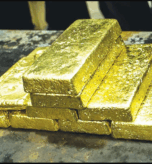
In 2022, the same year that 2,000 people died of hunger, the Ugandan government found an additional 31 million tonnes of gold ore beneath the country’s soil, with most of those mineral deposits in Karamoja. Now, some 60 per cent of the land in Karamoja is under concession to various investors, according to the charity Danish Church Aid.
Evergrande Resources Company Limited is one of the corporations currently looking for gold in Karamoja. Its operations are in Amudat district, 78 miles south of the Rupa mine where Ms Nakoru works.
According to the Ugandan government’s mineral cadastre, which tracks concessions granted to mining companies, Evergrande prospectors began exploring for gold in 2021. Last year, they applied for another exploration license, but it has yet to be granted. The company is registered in Uganda, but has Chinese and Ugandan shareholders.
“The water we have been using locally … has been contaminated by these modern chemicals,” says Paul Lodeba, a local leader in Amudat. “That has led to the deaths of human beings, animals and other environmental destruction.”
Less than a year ago, a twelve-year old boy named Daniel died after ingesting water tainted with chemical run-off from the Evergrande Resources facility, his father Benjamin Domougde told The Telegraph. The child had stopped for a drink while taking care of the family cow. Immediately, his father says, Daniel suffered from diarrhoea and vomiting. He died on the way to a health clinic.
Daniel was a well-behaved child who carried water for gold miners on weekends and school holidays. But he dreamed of abandoning mining to become a teacher. “The boy was bright in class. He used to be the best,” Mr Domougde says sadly.
Mr Domougde claims that Evergrande Resources provided the family with about £109 for the burial. He was working in the gold mines when labourers came with a casket, lowered it and filled the pit with cement. He was too distracted by his son’s death to remember to add a name marker to the grave. It is covered only with a tangle of brambles to keep animals from trotting where Daniel was laid to rest.
From the same spot, a whir of machines from the Evergrande Resources facility sounds like the buzzing of angry bees. We tried to visit this factory, which is separated from the surrounding village only by a length of barbed wire. Reporters saw a pile of blackish waste from mining but were blocked from approaching by a security guard.
At least 205 animals have died from drinking the same dirty water as Daniel, according to Mr Lodeba, the local leader.
The Telegraph interviewed Rogers Okello, the majority stakeholder in Evergrande Resources. Asked about the death of Daniel Domougde, Mr Okello sighs. “We told them to report first to the police,” he explains. “After reporting, as a company, we were going to take up expenses to make sure we do a postmortem.”
Mr Domougde refused to have his son further examined in the hospital, Mr Okello adds. Local custom dictates the dead be buried as quickly as possible. Mr Okello says that the police report was subsequently closed, but The Telegraph was unable to independently verify this.
“You don’t take the company and tarnish it for your own selfish interests,” Mr Okello said, insinuating the grieving father was looking for money. He adds that the company later checked the water, and found that it was not contaminated.
Artisanal miners, meanwhile, continue to dig for gold on whatever patch of ground they can find, fearing displacement if more mining companies arrive. “We are afraid, but there is nothing we can do. This is the source of our income, and this is how we live,” says Emmanuel Opio, a gold miner in Amudat, folding arms muscled from hauling stone for years.